
How to Plan a Bridal Shower Tea Party for 30+ Guests
Most tea party bridal shower advice online assumes you're hosting 12 to 15 people in a small tearoom. That's fine if your bride has a tight guest list. But if you're the maid of honor staring down a list of 40 names that includes the bridal party, both families, college friends, and the work group, those guides aren't going to help you. The logistics change completely at 30+ guests. Here's what you need to think about.
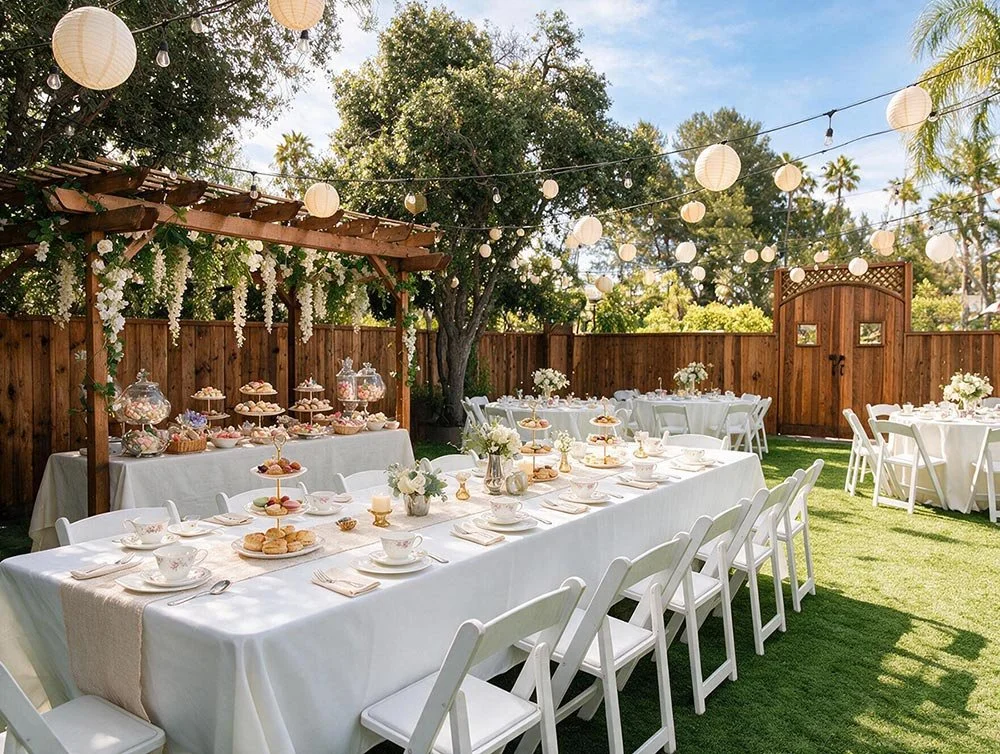
The Venue Question Changes Entirely
Small tearooms max out around 20 to 30 seats, and most of them aren't truly private. You're buying out the space, but the room itself is still tight. There's no area for gifts, no room for a photo setup, and running a game with 30 people elbow-to-elbow doesn't work.
At 30+ guests, you need a venue with real square footage. That means a private event space, a garden venue, or a restaurant with a buyout option that can run a tea service at scale. The non-negotiables: enough tables for everyone to sit at the same time, a service team that can pour tea and deliver food to that many people without the host doing any of it, and extra space for a gift table, a dessert or drink station, and somewhere to stage games or toasts.
Before you sign anything, ask the venue whether they provide the tea service in-house or whether you're bringing in outside catering. A venue with an on-site kitchen and staff who know how to execute afternoon tea for 40 people is a completely different experience than renting a pretty room and trying to coordinate a caterer on top of it.
Seating Is the Whole Game
At a small tea party, everyone sits at one long table and the intimacy takes care of itself. At 30+ guests, you're working with multiple tables, which means you need to think about the layout the same way you would a wedding reception (just on a smaller scale).
Put the bride at a central table where she's visible from every seat. Avoid pushing all the tables against the walls with a big empty middle, because that kills the energy and makes the room feel like a cafeteria. Round tables of 6 to 8 keep conversations intimate while still letting people see across the room. If you're working with long rectangular tables, keep them close enough together that the bride doesn't need a microphone just to thank everyone for coming.
Seat intentionally. The bride's grandmother and her college roommate are both going to be there. Put people together who will actually talk to each other, and put the people closest to the bride nearest to her. This sounds obvious, but it gets overlooked constantly at larger showers and the bride ends up stuck at a table with her future mother-in-law's coworkers while her best friends are across the room.
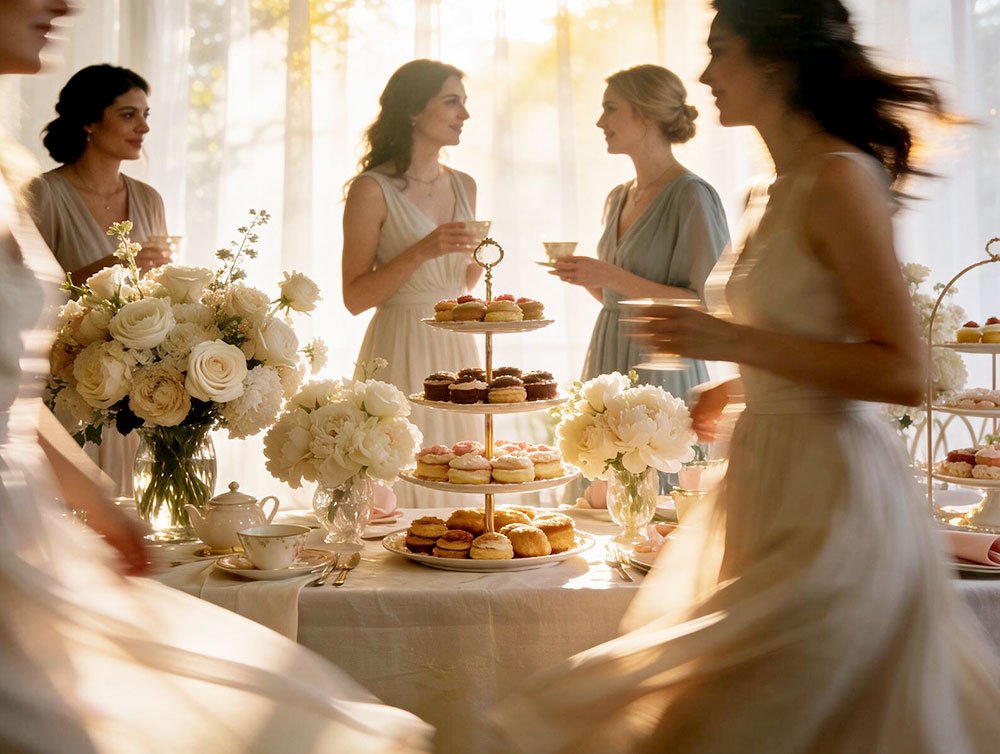
How Tea Service Works at Scale
The mechanics of afternoon tea don't change with a bigger group. Every table gets its own tiered stands with finger sandwiches, scones, and sweets. Every table gets its own selection of tea. The difference is execution.
At 15 people, one or two servers can handle everything. At 40+, you need a real service team. Tea needs to be refilled. Stands need to be refreshed. Water glasses, napkins, extra plates, all of it needs attention. If the venue doesn't have dedicated event staff for this, you're going to feel it, and you as the host are going to end up running around instead of sitting down.
Ask specifically how many servers will be assigned to your event. A good ratio for afternoon tea is roughly one server per two tables. If the venue quotes you one server for 40 people, that's a red flag.
Rethink Gift Opening
This is the single biggest planning mistake at large tea party showers. Forty people watching the bride unwrap 40 gifts takes well over an hour. That's an hour where half the room is checked out, scrolling their phones, and the intimate tea party vibe you built is gone.
You have a few options. A display shower, where guests bring unwrapped gifts and they're arranged on a table for everyone to see, keeps the energy up and frees up a massive chunk of time. Another approach: the bride opens gifts after the event and sends personal thank-you notes. If the bride genuinely wants to open gifts in front of everyone, pair it with bridal bingo so guests stay engaged. Hand out bingo cards before the opening starts, let guests mark off gifts they predicted, and award small prizes. It gives people something to do and keeps the energy from flatting out.
Pick Games That Work for the Room
Some bridal shower games that are great for 15 people fall apart at 40. Anything that requires going around the room one by one (like sharing a memory of the bride) will take forever. Anything that requires close physical proximity (like building a wedding dress out of toilet paper) gets chaotic with that many people.
Games that scale well at 30+ guests: place a printed card game or quiz at each setting so guests can play at their table (bridal trivia, "he said / she said," a tea-themed word scramble). The forbidden word game works at any size because it runs passively in the background. Bridal bingo during gift opening keeps the room engaged. If you want one bigger moment, a short video of the groom answering questions about the bride plays well to a large room and doesn't require audience participation.
Limit it to two or three activities total. At a large shower with food, drinks, mingling, toasts, and potentially gifts, adding five games turns the afternoon into a marathon.
You Need a Microphone
At 30+ guests, a room full of people chatting over tea is loud. The maid of honor trying to give a toast by just raising her voice doesn't work. Someone trying to explain the rules of a game by projecting from the front of the room doesn't work.
Check whether the venue has a sound system or at minimum a wireless mic available. If they don't, rent one or bring a small portable speaker with a Bluetooth mic. It's a $30 rental that saves the entire flow of your event.
Timeline for 30+ Guests
Two hours is tight but doable if you plan the flow in advance. Here's a realistic breakdown for 40 guests:
0:00 to 0:20 Arrival, mingling, guests find their seats
0:20 to 0:50 Tea service, eating, table conversation
0:50 to 1:05 Toast or short speech from the host
1:05 to 1:25 One or two games (table games can overlap with tea)
1:25 to 1:50 Gift opening (if doing it) or more mingling
1:50 to 2:00 Bride thanks everyone, photos, goodbyes
If you have the option to extend to two and a half hours, take it. With a larger group, every transition takes a few extra minutes. Arrivals stagger more. Gift opening runs longer than you think. Having a buffer means nobody feels rushed and the host isn't watching the clock during the toast.
Budget Reality
Afternoon tea pricing at most venues is per-person or tiered by group size. For 30+ guests, expect to spend somewhere between $1,500 and $5,000 depending on the venue, the menu, and whether drinks beyond tea are included.
The upside of a venue-hosted tea party at this scale: the cost is fixed and predictable, which makes splitting it among bridesmaids straightforward. Compare that to a DIY brunch for 40 people at someone's house, where the food alone can run $800+, you still need table and chair rentals, flatware, decor, and someone has to cook, serve, and clean up.
If budget is a concern, the biggest lever is guest count, not format. A tea party for 30 costs meaningfully less than a tea party for 50. Work with the bride to tighten the list before you start cutting corners on the experience.